Friday, October 9, 2015

Coffy Brown in Espana y Portugal !

So, I know that in my last post, I told all of you that I would be blogging every day from Spain during my vacation.  Unfortunately, the trip that I took was such a whirlwind that I was barely able to catch my breath. In addition, once I arrived home, I really needed some time to process the trip and give you my observations. I have separated this into four sections. Firstly, an overview and the nuts and bolts of my Iberian Peninsula vacation ;what I didn't like,  what I liked , and finally my recommendations on how to avoid the things that I didn't like, if you  happen decide that you'd like to take a tour.  Here goes!

Cosmos and Budget Travel


 Since inventing the budget vacation over 50 years ago, Cosmos has offered savvy, value-minded travelers the most affordable travel packages to the world's most captivating places - from the City of Brotherly Love to the City of Light…from the Great White North to Northern Africa…to tropical Hawaii,  there are few places in the world that Cosmos doesn't go! Their  incredible value helps travel buffs travel more often. Many people feel that travel, particularly international travel is far out of their reach. Because of companies like Cosmos, it isn't. They target the customer who wants to get out and experience the world and would rather have an extra day in an exotic location than a chocolate on their pillow and turn down service.  Cosmos' vacation packages feature comfortable clean hotels, ( some better that others) , guided city sightseeing: a comfortable motor coach with free wifi, and many meals. Now, I will freely admit that I got everything that they promised in the brochure. But, there were some quality issues here and there. The final hotel that we stayed at in Madrid was an absolute DUMP ( but they did sell me an adapter to charge my phone for two euros which was a deal. ) The hotel in  Lisbon was lovely, but the service  and food were atrocious. I honestly don't think that they liked Americans. The entire vacation , nine days, hotels and air  fare with the services of an outstanding Spanish and Portuguese speaking tour director , was $3, 074. That includes a $400 single supplement and $100 trip insurance. ( I always purchase trip insurance, you should too! That's a lie. I purchase it sometimes. ) I was able to make a down payment and pay for my trip in installments with the final payment due forty-five days prior to departure. Being able to make payments on a vacation a year or two years in advance makes them much more attainable for most people. Now, let's get to the bad stuff first. 


The Bad News ( what I didn't like)


 As I mentioned earlier, my vacation was a complete whirlwind and although it is absolutely what Cosmos promised, nine  cities in nine days is a bit overwhelming. The hotel quality was not consistent. Every place was neat and clean, but the final hotel was extremely rundown and the elevators made a serious grinding noise which made me worry a cable would snap at any moment. The hotel in Lisbon which was very nice,  had the most rude front desk staff that I have ever encountered and the food in most places left a lot to be desired. Now, some of my distaste for the food is cultural, ( not in Lisbon the food at Hotel Roma was just plain bad.) They eat a great deal of pork on the Iberian Peninsula and they don't brown it. Where I come from, "Thou Shalt Not Eat Rare Pork" is the eleventh commandment.  As a result, I ate a lot of fruits and vegetables on vacation and even ventured into a Hard Rock Cafe and a TGI Fridays while I was there. Oh, and Starbucks saved my life! ( If you want ice in a drink in Europe, Starbucks is your best bet . ) I generally don't eat at American restaurants while on vacation, but after nothing but fruits and vegetables,( which were actually very good by the way), I needed a steak.  The time difference from Madrid to Oakland, CA where I live is nine hours. So, I was tired the first couple of days. And then, midway through, just to make things interesting, the time went back an hour upon our arrival in Portugal. I paid for several optional excursions while on vacation. There were a few that could have been better.  A Fado  ( Portuguese folks music) show with dinner ( the dinner was not impressive),  a tour of Madrid where the tour guide couldn't seem to stop talking about the most gory aspects of bullfighting ( even when we made it clear that we found bull fighting distasteful ), and a tour of Seville that didn't really cover the areas of Seville that I wanted to see. I never saw the Metropol Parasol which was  one of the attractions that I was  most excited  to see. Any formal city tour should have included  it.  I also think that they need to get guides who actually speak English. Now, many of them claimed to speak English, but as far as I'm concerned, their accents were so thick that what language they were truly speaking was questionable. 


The Steak sandwich that I ordered from the Hotel Roma. I took one bite and threw it away. 


Our Lady of Fatima

One of the most polarizing stops on the tour was the visit to Fatima, Portugal.   The name of the town and parish evolved from the Arabic name Fatima, the name of a Moorish Princess and ultimately, the daughter of the prophet Muhammad.  The history of Fatima is associated with three local children: Lucia dos Santos and her cousins, Francisco and Jacinta Marto, who on May 13, 1917 , while guarding their sheep in the Cova da Ina , witnessed an apparition of a lady dressed in white.The lady, later referred to as Our Lady of the Rosary, indicated that she was sent by God with a message of prayer, repentance and consecrations. She visited the children on the 13th day of each month from May to October. The last apparition occurred on October 13, 1917,  the 70,000 pilgrims in attendance witnessed the "Miracle of the Sun. ".The Miracle of the Sun was an event which occurred just after midday on Sunday , October 13, 1917, attended by some 30,000 to 100,000 people who were gathered near Fatima, Portugal. Several newspaper reporters were in attendance and they took testimony from many people who claimed to have witnessed extraordinary solar activity. This recorded testimony was later added to by an Italian Catholic priest and researcher in the 1940s.
According to these reports, the event lasted approximately ten minutes. The three children (Lucia dos Santos, Jacinta Marto and Francisco Marto) who originally claimed to have seen Our Lady of  Fatima also reported seeing a panorama of visions, including those of Jesus, Our Lady of Sorrows, Our Lady of Mt. Carmel and of  Saint Joseph blessing the people.
The event was officially accepted as a miracle by the Roman Catholic Church on  October 13, 1930. On  October 13, 1951, the papal legate , Cardinal Teschini  told the million people gathered at Fatima that on  October 30, October 31, November 1, and  November  8, 1950, Pope Pius  himself witnessed the miracle  of the sun from the Vatican gardens.   Our Lady of Fatima  gave the children a message that consisted of three secrets: first, a vision of Hell,  "where the souls of the sinful would travel" without prayer; the second, prophesied the beginning of the Second World War; and ultimately, the mysterious Third Secret , which Dos Santos transcribed in 1944, and has been held by the Vatican since 1957.

  The Lady asked the children to do penance and acts of reparation and make personal sacrifices to save sinners. The children who were all no older than nine , complied by wearing tight cords around their waists, beating themselves with stinging nettles, abstaining  from drinking water on hot days, and performing  other acts of penance.  This is my first issue with the miracle of the apparitions .  Although I am a person of faith, I simply do not believe that God tells people  ( and certainly not children) to harm themselves.  Fatima, Portugal is now the most visited religious site in Europe. There is a fountain with miracle water and a thriving consumerist economy in Fatima, all based around the apparitions viewed by the children .  This  segways into   my second issue with the stop in Fatima, Portugal. The  water from the miracle fountain  is free, however,  you can buy all manner of bottles to put it in. There are also a plethora of religious artifacts available for purchase and there is an eternal flame where people can light candles and pray to the Virgin Mary for intersession with a problem. The candles are the standard length and some are as long as five feet. What is the religious significance of the length of the candles? The only difference is how much you can afford to pay to purchase them.  The best description of Our Lady of Fatima in my mind is a   " Mc Shrine".   I felt more like I was in the temple with the money changers than a holy place. So, while many on the tour  filled their bags up with bottles of miracle water, glow in the dark Rosary beads, and  plastic key chains featuring  the Virgin Mary and the Pope,  I went and found a bar. ( Yeah, I said it.) 

Basically, I could have done without this stop entirely. 


The Good News (What I liked)


So, the Spanish way of life is vastly different from the way we live in America. They say that Siesta is the national sport of Spain. What is Siesta? Well, the Spanish actually take three hours out during the middle of the day in order to go home and eat lunch as a family. After the three hour break, they return to work/school,  and work another three to four hours, finishing their workday around eight in the evening.  This later scheduling and Siesta is the result of the location of Spain and it's relation to the sun. Here in America, noon is considered mid-day because that is the time the sun is highest in the sky.  As such, noon, mid day is lunch time. The Spanish have lunch when the sun is highest in the sky as well. But, that doesn't happen at noon. The sun is highest in the sky at around 2:20 - 3pm. ,and that is when they take lunch and why lunch and everything else is so much later than what we as Americans are accustomed to. It can still be light out at 11pm in Spain. The Spanish enjoy a very social lifestyle. At the end of the work day, they head to the square and connect with friends and family. It doesn't matter that it's the middle of the week. No one waits until the weekend to enjoy life and have fun. In the evenings, the streets are filled with people out and about enjoying life. Side walk cafes  and restaurants are bustling with activity and camaraderie.  although it may take a while to get waited on in a restaurant, ( the waiters often act as though you are bothering them when you sit down at a table)  the Spanish have a "Big Easy " sort of attitude where everything is taken in stride and timeliness is not as important as it is to us here in the States. ( this may be part of the reason that their economy is not doing so well. )  Basically, the Spanish work to live, they don't live to work. 


The Coliseum in Italica held 26,000 people.

Me in Italica just outside Seville, Spain


Man having a puppet show in Salamanca

Seville , Spain


Avila, Spain 

The view from the top of the hill in Coimbra, Portugal

Walking the streets of Avila, Spain

There's an astronaut on the molding of the 300 year old church in Salamanca!

A window in Salamanca, Spain. The entire city is made of that golden stone.

Grapes vines hanging from a balcony in Salamanca, Spain.

The river outside our first hotel in Madrid. The first one was nice. The second, was questionable.

Me at the top of the hill in Lisbon, Portugal before the Fado show.

The Grand Mosque Cathedral in Cordoba, Spain

The Grand Mosque Cathedral in Cordoba, Spain
The Statue is a message that the musician should play the instrument in the same way that he would caress a womans's body. Coimbra, Portugal

The back of the above statue, Coimbra, Portugal

They like pork in Spain and Portugal.

Photo of me in the ancient walled city of Avila.

Moasaic tiles at the from the bottom of a pool in Italica.

A passage way in Coimbra.

Me and my friend Maggie from Egypt!

Obidos, Portugal

Ancient Roman decorations on the entrance to Obidos, Portugal!

They REALLY like Pork in Spain and Portugal.

Me on the tour bus in Lisbon, Portugal!

One of the residents of Obidos.

Cordoba, Spain


The Grand Mosque Cathedral Cordoba, Spain

The Grand Mosque Cathedral, Cordoba, Spain


As I mentioned earlier, we visited several small towns, and even though I was in a whirlwind and dead dog tired, I am glad that we took time to stop and visit the  small towns in Spain and Portugal.  Avila, Coimbra, Salamanca, and Obidos took my breath away. They are old charming cities with beautiful architecture, and unlike in the larger towns, the inhabitants were very warm and welcoming. I suspect that tourism has a much more direct impact on what goes on the dinner table in the smaller towns and they truly did  not  appear to resent our  presence. Also, the prices of goods were outstanding. I purchased handmade items  for fabulous prices that would have easily cost me four or five times as much in the U.S. The small town residents  also take pride in their cities and seem to enjoy it when they see appreciation mirrored in the faces of visitors.

An additional  aspect of the tour that I  really enjoyed were the  other people from all over the world who were on it. The only thing we initially had in common is that we all spoke English.  I met people from Canada, Egypt, Australia, Saudi Arabia, and Scotland. I am still in contact with a couple of them via email, and I doubt that I would have been able to have such an engaging experience with people from all over the world had it not been for this tour. One more cute little bonus was that I was able to see a couple of singles ( Not Me) make a love connection. They started out not knowing each other and by the end of the tour, they were taking all of their meals and tours together and romance was in the air. 

The two sites that struck me the most during my vacation were the ancient Roman City of Italica and the Grand Mosque of Cordoba. Italica is a Roman city that is around two thousand years old. At it's height, there were 250,000 inhabitants. Roman building techniques were so advanced that these people had indoor plumbing and the sewer system is still intact. ( the palace at Versailles was built hundreds of year after Italica without one single bathroom. ) Next, the Grand Mosque at Cordoba. Cordoba was the capitol of the entire region under Moorish Rule. At a time when England had eight thousand inhabitants and Paris had four thousand ,  Cordoba had one million. Being in Cordoba, the ruins of Italica , Avila, Coimbra, Obidos, Salamanca  was like walking in a living breathing artwork by one of the old masters. And, although I would not recommend that you take the whirlwind trip that I did, these cities are something that everyone should see once in their lifetime . They were magnificent. 


My Recommendations


So, as I mentioned earlier, my trip was a whirlwind. Even though we spent overnights in five cities, I still was barely able to catch my breath. One of the reasons for this was all of the optional excursions that I took. I toured Lisbon and attended a Fado show, toured Seville and also attended a Flamenco Show, toured the Grand Mosque at Cordoba,  and attended Madrid by night with Tapas ( that meal was delicious. We ate pork cheeks. But, they were well seasoned and well done, so I thought that I was eating a pork roast.) I  participated in all of these excursions along with the excursions included in the tour. If I had it to do over again, I would not have signed up for any  additional excursions. I could have visited Italica, and the Grand Mosque of Cordoba without being on an organized tour.  I would have enjoyed both more just observing and going at my own less accelerated time table. In fact, lets talk about the itinerary. Since our schedule was so tight, we had a number of very early wake up calls, something that I don't like EVER, but certainly not on vacation. We spent more time on the tour bus than I would have liked. The tour director was very entertaining and the motor coach was air conditioned and comfortable with WIFi. But, that was time that I  could have spent just enjoying the cities that we visited. Now, with all that being said, I would take another tour. Traveling as a single,  a tour gives you added protection . There is someone there looking out for you and if you want to make friend, most other folks are very welcoming. Especially, other singles who are looking for someone to hang out with.  Of course, the next tour that I take will be of a different type and this is what I would also recommend to you. Many tour operators, including Cosmos offer Independent tours. I actually have my eye on one that includes 
Dubai, Bangkok with an extension to  Phuket for next year. What will be the difference? In an independent tour, the tour company arranges your hotels, and flights. There is a local point person to give you suggestions on what you might like to do and what restaurants are good, but once you arrive in the city, your time is your own. There might be a short train ride or flight from city to city, but you won't spend extended time rolling along the countryside.  You get the benefits of packaged pricing which is almost always better than purchasing airline and hotels individually but, you are on your very own schedule. Next time, I will also pay a tad bit more in order to get nicer accommodations. In fact, the tour that I  am considering offers very nice hotels and AMERICAN breakfast every morning as a part of the package. ( No more undercooked bacon for me.) An additional issue on my tour that some might find challenging was the age demographic of most of the attendees. I think the average age was fifty-five with a few folks in their thirties and forties and quite a few who were retired. The way to get around that, if you're not interested in an independent tour is to try Contiki tours. Contiki has an age demographic of eighteen to thirty-five years old with most attendees somewhere in between. 

In conclusion, as I stated earlier. Yes, I absolutely without a doubt, would take another tour. In spite of some challenges, I would not give up the experience I had on the Jewels of Spain and Portugal tour for anything in the world. Travel changes you. It enhances who you already are. It expands you in ways that no other experience can.  And, your Miss Brown is no exception. I am a richer, bolder and a more flavorful version of the force of nature that you already know.  And , once you step out and view another part of the world, whether in the states or abroad, you will be too! That's all for now....as  always...

Keep it  Caliente y Dulce!

Miss Brown


PS- if my photos seem to not have any rhyme or reason with regard to placement, simply a reflection of my whirlwind experience. 


Wednesday, August 19, 2015

Judi Oshowole on life in Barcelona


Judi Oshowole founded Barcelona International Black Sisters, a group of women of African descent living in Barcelona, Spain. I will be visiting Spain next month, and I must admit that I am very curious about the black experience there. I won't be going to Barcelona, but I will be going to Madrid, Cordoba, Seville, Coimbra, Obidos, and Lisbon, Portugal. My post will be a bit different while I'm on vacation. I plan to give you a daily log of my adventures. I hope that you enjoy it as much as I will!

As Always...

Mantenerlo Caliente y Dulce,

Ms. Brown

Tuesday, August 4, 2015

Get Waisted


  It seems that the hourglass figure has  once again become en vogue ( keeping it real, it never went out of fashion in the black community) and as with any other form of beauty, women are making great efforts to achieve it. One trend that I have noticed of late is the craze toward waist training. Waist training is the gradual process of waist reduction using a waist cinching corset.The waist training practice came into prominence in Victorian times but has made a something of a comeback in recent years.  The resurgence of this trend  interested me, and I thought that I would do a bit of research and tell you about it.  As I said earlier ,the waist trainer is merely the modern day equivalent of a corset.  Corsets have been around for at least four hundred years. I am most fascinated with the  corsets of the  Victorian era and the resurgence of corsets today.


Tight- Lacing
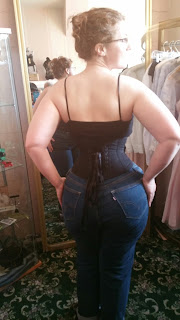
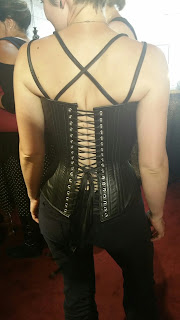
Dark Garden Corsetry Customer tight-lacedl


Prior to 1850, corsets had  the role of bra. As opposed to narrowing the waist, corsets were shaped with bust cups and made from  materials still used today. They were closed with elastic laces and elastic thread was often used in the material to give the fabric more stretch. At the time, exaggerated shoulders and skirts made the waist appear narrow. When the exaggerated shoulders disappeared, the waist had to be cinched more tightly in order to achieve the same effect. This is around the time that the practice of "tight lacing " began to appear. "Tight lacing" is the practice of wearing a tightly laced corset. It is done to achieve cosmetic modifications to the figure and posture or to achieve the sensation of body restriction. 

( Yes, some folks are aroused by having their bodies tightly restricted. But, with the advent of "Fifty shades of Grey" this should not come as a surprise.)


A typical training routine begins with the use of a well-fitted corset and very gradual decreases in the waist circumference. Lacing too tight too fast can cause extreme discomfort and short-term problems such as shortness of breath and faintness ( hence all the swooning and the fainting couch that we have heard about in historical fiction), indigestion, and chafing of the skin if a liner is not worn. It should also be noted that lacing too tight or too fast can irreversibly damage a corset and they should be seasoned appropriately.


The primary effect of tight lacing is the decreased size of the waist. The smallest waist recorded is that of Ethel Granger, who tight laced for most of her life and achieved a waist of 13 inches (33 cm): a reduction of over ten inches. Such extreme reductions take a very long time to achieve. At first, corsets with waist measurements four inches smaller than the tight-lacer's natural waist size are recommended. The length of time it will take a tight-lacer to get used to this reduction will vary on his or her ( yes, men wear corsets too) physiology; a large amount of fat on the torso and strong abdominal muscles will mean that it takes longer for the tight-lacer to wear their corset laced closed at the back. Thereafter, reducing another couple of inches is not much more difficult, but each inch after a six-inch reduction can take a year to achieve.
Tight-Lacing 


Tight -Lacing

A Gibson Girl Tight-Laced. Gibson Girls were the beauty ideal in the 1900s. This photo would have been pornography. 


The diminished waist and tight corset reduce the volume of the torso. This is sometimes reduced even further by styles of corset that force the torso to taper towards the waist, which pushes the lower ribs inwards. As a consequence, internal organs are moved closer together and out of their original positions in a way similar to the way that a pregnant woman's expanding uterus causes the organs to be displaced.
The volume of the lungs diminishes and the tight-lacer tends to breathe with the upper portion of the lungs only, rather than the whole. This sort of  breathing is what gives the image of "heaving bosoms"  that are so often mentioned in historical romance novels.  Due to the lower portion of the lungs being used less there is often a bit of  a mucous build-up there; a slight and persistent cough is the sign of the body trying to clear this (and might also have led to the Victorian hypothesis that corsets caused tuberculosis.)
The liver is pressed upwards.  As it continually renews itself, it adapts to fit its new position, and in a long-term tight-lacer it can develop ridges where it rests against the ribs.
The compression of the stomach  reduces its volume, and some find  that eating too much gives them indigestion and heartburn; foods like carbonated drinks and beans can easily cause trapped wind. The compression of the intestines can cause constipation that usually resolves upon removal of the corset. Many tight-lacers will alter their diet in order to avoid these problems, for example going from three large meals a day to six smaller meals.


Waist Trainers


What has helped waist trainers become so popular of late is the wide endorsement of many celebrities. Kim and Khloe  Kardashian, Kim Zolciak, Snooki,  and Blac Chyna have all admitted to wearing corsets and firmly endorse them.  ( Okay, so the jury is still out on whether or not any of these people are bonafide celebrities, but I suspect that their firm advocacy has certainly cemented the waist training craze in popular culture.)  There are three basic types of waist trainers:

  • Latex waist trainers - are considered to be the “starters”. They are more flexible because they only have a few weak bones which allow you to move more freely. Still they may show from under clothing because they make some weird wrinkles on the sides. It is also advised to wear something under the latex model because it can be irritating to the skin. Latex are  considered to be the best trainers to wear in the gym during workout.( In the gym during a workout? Yeah, right...)


  • Corset waist trainers- have more layers and are more rigid than latex trainers. They can have decorative elements like lace and drawings but their fabric allows skin to breathe. Because they are more rigid they don’t wrinkle and they keep the waist tight in.


The first two waist trainers that I mentioned run in pricing from about $10 to $150 dollars. I basically consider them to be the Walmart ( latex) and Macy's (corset) of waist trainers. 


Dark Garden Corsetry and Couture

So, the third type of waist trainer is the Ribbon Corset waist cincher. This is a corset that can be customized after your body shape and size. It has lacing at the back ( just like in the movies) and can tighten to the preferred size. ( it is impossible to put these on or remove them properly alone.) So , if latex waist trainers are the Walmart of Corsetry. And, a basic corset is the Macy's of Corsetry, then Dark Garden Unique Corsetry located on Linden St. in San Francisco is the Sex, Chocolate, Beyonce of Corsetry. On Sunday, July 19, 2015, your  Ms. Brown attended their Annual Corset Rummage Sale and I had a blast! Since it's inception in 1989, Dark Garden has established itself as one of the world's leading corsetiers, specializing in custom figure shaping foundation garments. Each corset is designed to function as a corset should, without sacrificing comfort. Dark Garden has a reputation for making structurally sound yet comfortable corsets which has attracted the attention of celebrities and corset enthusiasts the world over. There are three distinct collection at Dark Garden; The Signature starting at $315, Risqué starting at $430, and the Dolly Mop starting at $365.  All corsets come in 18" to 38" which roughly is a size 2 to 22.  Dark Garden also makes custom corsets in 12" to 40" inch sizes. The price starts at $895.  They also have a full bridal salon.  The sale began at 11 am and I'm told that the line was approximately four hours long.  I arrived in the afternoon and waited only about twenty-five minutes. The issue with that of course is that many of the best items were probably sold by the time that I was able to enter. In any case, the people in line were sooo nice. Someone brought donuts and they were happy to give me the ins and outs of corset wearing. Now, I was surprised to find that both men and women wear corsets, but hey, clearly there is an entire culture of corset wearing with which I'm not familiar! Once I got in, I was fitted for my corset by Tiffany!  After doing my research on corsets and waist training culture, I  must admit that I was a bit concerned about wearing one. Ms. Brown will not wear anything that prohibits her from breathing or eating.Those are two activities that I enjoy immensely. But, I was pleasantly surprised to find that I could breathe easily and I honestly could see myself enjoying a meal in the garment with no problem. It actually felt good to have the additional back support.  Now, as you can tell, Dark Garden Corsets are not inexpensive, even when they're on sale. But,  they were definitely in a class by themselves with regard to fit, style, and quality. So, if you're in the market for a corset, I would recommend that you hold on to your money until you can get one from them. Take it from me, i tried on a cheap one and it was not the same.  I have my eye on getting this leather corset custom made.( I don't think that I've seen anything more bad ass in my entire life or at least not since Naomi Campbell walked the runway for Atelier Versace in 2013)   

Here are some photos from the event : 
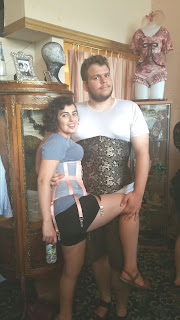
A couple of satisfied customers!

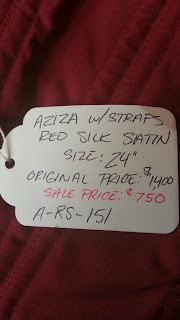
An example of pricing. 

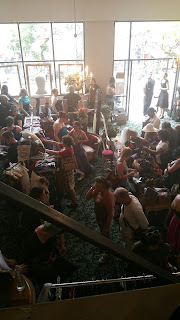
The store from the loft! 
Dark Garden Sales Associate working it!
Tiffany the Fabulous! She's the sales associate who assisted me! 
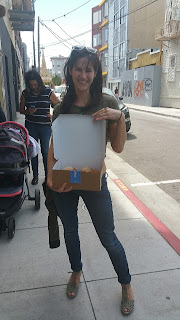
A Dark Garden Customer sharing pastries while we waited in line!,


This leather corset was EVERYTHING! I'm saving up for one ! They're custom made. Retail $1200.  


Let me be clear, the effects of waist training are not permanent and I don't  know if it's a good idea to wear anything ( other than gym clothes) with the goal of taking ten inches off of your waist. It honestly sounds unrealistic and painful. But, if you're looking for something hot, unique, and sexy  to wear to the next event( that you know everyone won't have), I would heartily recommend a Dark Garden Corset.  Until next time...

Get Waisted!

Ms. Brown
My "I got Waisted at Dark Garden " Tee
Retail: $25

Friday, July 17, 2015

Come Out to The Castro Walking Tour


The Castro District commonly referenced as The Castro is a neighborhood in Eureka Valley in San Francisco, CA. The Castro is one of the first gay neighborhoods in the United States and has been one of the most lively for several decades. But, the Castro has not always been the epicenter of the Gay community and activism. I became curious about how the Castro became such a prominent symbol of of gay activism and events in the world. So, I decided to learn more about it. to that end, on Saturday, July 11, 2015, your Ms. Brown decided to take the  Come Out to the Castro Walking Tour. 

The Gold Rush

Castro Street and  was named for Jose Castro (1808–1860), a California leader of Mexican opposition to U.S. rule in California in the 19th century, and alcalde of Alta California  from 1835 to 1836. The neighborhood now known as the Castro was created in 1887 when the Market Street Railway Company  built a line linking Eureka Valley to downtown. However,  much of the growth of San Francisco and the expansions that later took place were the result of the now world famous "Gold Rush". The California Gold Rush  (1848–1855) began on January 24, 1848, when gold was found by James W. Marshall at Sutter's Mill in Coloma, California.  All told, the news of gold brought some 300,000 people to California from the rest of the United States and abroad. Of the 300,000, approximately half arrived by sea, and half came overland from the east.

The effects of the Gold Rush were substantial. San Francisco grew from a small settlement of about 200 residents in 1846 to a boom town  of about 36,000 by 1852s   However, that boom town did not feature many women. The men often found ways to entertain themselves. One of the most favorite past times was square dancing. The men used an at first a simple handkerchief code. A mustard yellow hanky in your left pocket meant that you were the lead while dancing. The same hanky in your right pocket meant that you took the more submissive role in dancing and were the follower. Eventually, these codes transitioned into meaning other things of a more sexual nature. In fact today,the hanky code has become quite extensive. Below is the partial  list of hanky codes and what they mean: 

Color/ Hanky left/Hanky right

Color/Hanky left/ hanky right


For a full list of handkerchief codes and meanings along with events go to :
P. S.- if you don't know what something means, don't ask me. I don't either. As I always say, that's why God created Google. 

Working Class Neighborhood

After the Gold Rush, the Castro District transitioned into an average working class community. In the early 20th century - especially from c. 1910 to 1920s - the Castro District of San Francisco and some of the surrounding area was known as Little Scandinavia, because of the large number of residents of SwedishNorwegian and Danish ancestry. Later,  the Castro became home to a large number of Irish Catholic families. Much of the Irish Catholic roots of the area can be seen in the large number of bars that exist in the Castro presently (no shade.) Those establishments and their corresponding liquor licenses are remnants of the large number of Irish Pubs that existed in the community in times past. One establishment that clearly exhibits the Irish Catholic Roots of the Castro is the Twin Peaks Tavern located on the corner of Castro and Market. The tavern features vintage antique woodwork throughout along with corresponding vintage furniture. If you visit the Castro, let me just suggest that you at least go into the Twin Peaks Tavern and take a look. The woodwork is outstanding. 


World War II


World War II provided a big impetus for the development of San Francisco's gay community. One and a half million soldiers, 10%+ of which were homosexual, were able to find each other more easily in the marginal districts of San Francisco. Many soldiers and sailors came to the area and some  formed gay relationships. Later, they were discharged for homosexuality. Ultimately, the  U.S. military dishonorably discharged thousands of gay servicemen from the Pacific theater in San Francisco during World War II (early 1940s) because of their sexuality.  Upon their discharge, the Military sent a letter home to the serviceman's  family members detailing why they were discharged. Rather than returning home where they would be stigmatized, many  stayed on and after the war were joined by thousands more who had discovered new identities during the war.   The city was always known for its relatively libertine attitudes towards sex and pleasure. The Barbary Coast and the waterfront brought together travelers, sailors, transients, and other casual encounters far from the prevailing  rules "back home". Hundreds of houses of prostitution flourished from the Gold Rush through the early 20th century,followed decades later by the rise of topless bars and strip joints, the pornographic film industry ( The Mitchell Brothers being the best known), all contributing to the sexual openness that gave San Francisco a reputation directly challenging the sexual repressiveness that prevailed in the rest of the country.  This in turn made San Francisco an attractive destination for those deemed "outlaws" by the dominant morals of society. San Francisco ultimately  developed an established gay community  in numerous areas including Polk Street, the Tenderloin and south of Market Street. The 1950s saw large amounts of families moving out to the suburbs in what became known as the "White Flight", leaving open large amounts of real estate and creating attractive locations for gay purchasers. By 1963, the Castro's first gay bar was opened called the "Missouri Mule".


The Castro's graduated to it's status as a gay mecca began during the late 1960s with the Summer of Love in the neighboring Haight-Ashbury district in 1967. The two neighborhoods are separated by a large mountain, topped by Buena Vista Park. The hippie and free love movements had fostered communal living and free society ideas including housing of large groups of people in hippie communes. Androgyny became popular with men even in full beards as gay hippie men began to move into the area. The 1967 gathering brought tens of thousands of middle-class youth from all over the United States to the Haight which saw its own exodus when well-organized individuals and collectives started to see the Castro as an oasis from the massive influx. Many of the hippies had no way to support themselves or places to shelter. The Haight became drug ridden and violent, chasing off the gay population who looked for a more stable area to live.
The gay community created an upscale, fashionable urban center in the Castro District in the 1970s. The neighborhood previously known as Eureka Valley, became known as the Castro, after the landmark theatre by that name near the corner of Castro and Market Streets. Many San Francisco gays also moved there after about 1970 from what had been the formerly most prominent gay neighborhood , Polk Gulch, because large Victorian houses were available at low rents or available for purchase for low down payments when their former middle-class owners had fled to the suburbs.In 1962 police and alcohol control board harassment led to the establishment of the Tavern Guild, consisting of the owners of primarily gay and bohemian establishments. The Guild became the first overtly gay business association and provided one of the first organizational backbones of the gay community. Earlier, in 1955, the Mattachine Society (one of the first ever gay organizations) had moved its headquarters from Los Angeles to San Francisco and eventually spawned The Advocate, the nation's first gay magazine. The Daughters of Bilitis, the first openly lesbian organization, was founded in San Francisco, also in 1955. 
Resident in the Castro who does doll displays!
Kim, our tour guide wearing the boa of fame!

The first winner of the boa of fame!


The Tour

So, the above is just a teaser of all the information that I took away from the "Come out to the Castro Tour'. And truly, we discussed far too much to insert into one blog post. I learned that the size of each patch on the AIDS quilt is equivalent to the size of a grave. I learned that the Walgreen's in the Castro is the most profitable in the country as a result of filling prescriptions for AIDS and HIV medications. I learned that Jewish Holocaust victims who were gay were forced to wear pink triangles. ( Google Pink Triangle Park). And, all the information was presented in a fascinating  and engaging form. We had funny quizzes and jokes that each tour participant were challenged to answer or perform. The winner was allowed to wear the "boa of fame". I never answered a question correctly, so I never had my turn with the stupid "boa of fame". ( I'm still bitter, can you tell?) The "Come out to the Castro " Tour happens every Saturday. The price is thirty dollars per person or fifteen on Goldstar(what I paid.) I had a fabulous time, learned a lot, and got a bit of exercise in the sun. I plan to take all of the other walking tours of various neighborhoods in San Francisco, and perhaps I will get the 'boa of fame" or some similar achievement next time! One can always hope! As Always...
Keep it Hot and Sweet!
Ms. Brown